Budapest has a lot of wow in 90 minutes. This self-guided walk mixes Andrássy Avenue glamour, the old Jewish quarter, and a firsthand feel for the city’s later-night side at Szimpla Kert—all powered by your phone in the Rewind app. The stories come from professional guides and actors, so you get more than random facts.
I love the freedom: you can start when you want and walk at your own pace. I also like how the route stitches together big landmarks (like the Great/Central Synagogue) with street-level texture in places such as Gozsdu Passage. One possible drawback: you’ll rely on getting your booking to link properly inside the Rewind app, and that’s one snag to handle early.
In This Review
- Key highlights at a glance
- A smartphone guide that keeps you moving through Budapest
- Starting point and the Andrássy Avenue atmosphere
- House of Terror Museum: powerful subject, plan around the ticket
- Oktogon and the city’s road evolution
- Jókai Street and the Jókai soup connection
- The Hungarian State Opera: classic grandeur near the walk
- The Jewish Quarter as it is today: streets, stories, and synagogues
- Gozsdu Passage: the lively in-between space
- Szimpla Kert and the idea of the ruin bar
- Pace and timing: how to make 1h30 feel satisfying
- Price and value: why $14.47 can work for the right traveler
- The best fit: who will enjoy this walk most
- Should you book this Budapest Jewish Quarter festive walk?
- FAQ
- How long is the Budapest Festive and Old Jewish District Self-Guided Walking Tour?
- What do I use to access the tour stories?
- Are there any places where admission tickets are not included?
- Where do I start and where does the tour end?
- What hours can I start the self-guided walk?
- Is this tour private to my group?
- Is free cancellation available?
Key highlights at a glance
- Rewind app guided audio with stories triggered automatically as you move
- Flexible start time during the day, so you’re not stuck to one departure
- Great/Central Synagogue focus including the history of the Jewish community in Budapest
- Szimpla Kert ruin bar slot for a real taste of Budapest’s nightlife culture
- Andrássy Avenue landmarks including the UNESCO-listed boulevard and the nearby Opera building
- Short stop format designed for an easy 1h30 walk without marathon pacing
A smartphone guide that keeps you moving through Budapest
This experience is simple in the best way: your phone becomes the guide. You use the Rewind app, and the audio stories are triggered along the route, with input from professional guides and actors. You’re free to go solo or walk with your group, but the “only your group participates” setup means you’re not merging into a crowd of strangers.
For me, the big value is control. In a city like Budapest, weather can change fast, and walking routes can feel better when you can slow down, linger, or speed up without negotiating a group pace. You’re also not tied to a single fixed moment—you start whenever you want inside the posted window.
That said, the format is only as smooth as the app experience. If your phone can’t connect to the booking correctly, the tour turns from easy to annoying. If you’re the type who hates tech surprises while you’re traveling, I’d plan to sort things out before you’re standing at the first stop.
You can also read our reviews of more walking tours in Budapest



Starting point and the Andrássy Avenue atmosphere
You begin in central Budapest at Budapest, Vörösmarty u. 37, 1064. From the start area, the route pulls you toward Andrássy Avenue, the UNESCO World Heritage Site boulevard (listed since 2002) that’s famous for luxury boutiques today.
Even if high-end shopping isn’t your thing, Andrássy Avenue is worth your attention for the street feel. It’s described as the Champs Élysées of Budapest, which is a good mental cue: wide boulevard energy, elegant buildings, and that sense that you’re walking along something that matters. The route’s short stop time also keeps it practical—think orientation, photos, and a few key facts, not a long detour.
If you want a more scenic rhythm, I’d position your walk so you catch the boulevard when you have decent daylight. The avenue’s appeal is visual, and the buildings and storefronts can read differently depending on the light.
House of Terror Museum: powerful subject, plan around the ticket
The walk touches House of Terror Museum as Stop 1. This is an evocative museum that focuses on the story of Hungary during the communist period. The catch: you’ll spend about 5 minutes there in the walking flow, and admission is not included.
So what should you do with this stop? If you want deeper time inside the museum, you’ll need to budget for a separate ticket and accept that it will stretch your timing beyond the quick walking moment. If you’re trying to keep the walk to around 1h30, treat the museum area as an on-the-street context stop and let the audio explain what you need.
One practical consideration: this is not a neutral topic, so if you’re sensitive to political history, you might want to mentally prepare before you reach it. The museum itself is designed to hit hard, and the route deliberately frames it through the broader city story.
Oktogon and the city’s road evolution
Next up is Oktogon, where the tour gives you a surprising bit of urban history. Until the 19th century, this area was described as a backwater of the Danube where boats could sail, before it was integrated into Budapest’s road network.
That kind of fact changes how you read the street. Instead of seeing Oktogon as just a crossroad, you start noticing it as evidence of Budapest’s growth and reshaping over time. This stop is free and brief, so you’re not losing time to transit; you’re gaining a mental model for how the city developed.
If you like photography, intersections often provide strong angles, especially at busy junctions. Just keep your footing—busy zones can mean traffic noise and crowds, even when the walking stop itself stays short.
Jókai Street and the Jókai soup connection
The route then shifts into a more everyday Budapest lane at Jókai Street (Rue Jokai). Here the tour ties the name Jokai to food—one of the best Hungarian soups is called Jókai soup.
This is a small detail, but it’s exactly the kind of connection that makes a walking tour feel grounded. It helps you stop seeing Budapest as a list of famous buildings and start seeing it as a place where names, language, and daily life overlap. You’ll also be better prepared for meals once you know the term you’re likely to see on menus.
Because this stop is quick, it’s more about learning a cultural reference than making you hunt for a restaurant. Still, if you want to follow the thread, keep Jókai soup in mind when choosing dinner later.
You can also read our reviews of more guided tours in Budapest






The Hungarian State Opera: classic grandeur near the walk
Stop 5 is the Hungarian State Opera, where the building is described as inspired by the famous Opera Garnier in Paris. Even in a short walk-by moment, you’re getting a sense of Budapest’s ambition with architecture and performance culture.
If you’re into opera or just into grand buildings, this kind of reference matters. The inspiration link gives you something to look for visually—features that echo the French legacy in a Hungarian setting. It’s also a nice contrast after more solemn history content earlier in the route.
One thing to watch: because this stop is free and brief, you’re not getting a guided interior visit. Plan to admire from outside and move on unless you already have a separate ticketed plan.
The Jewish Quarter as it is today: streets, stories, and synagogues
After the earlier city landmarks, the walk lands in the heart of the experience: the Jewish Quarter, described as the old Jewish quarter of Budapest and now associated with the festive district. This is the section where the audio guide gives you more emotional and cultural context, and you’ll likely feel the change in the feel of the streets.
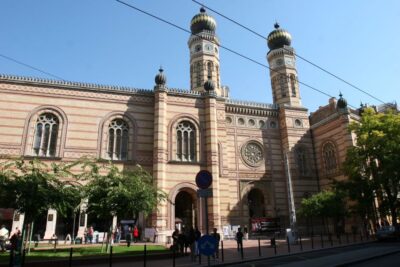
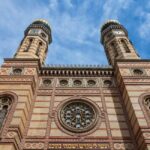
Stop 8 is the Great / Central Synagogue (Nagy Zsinagóga), framed as the largest synagogue in Europe. That size detail helps you understand why this landmark is a core part of the area’s identity. You also learn about the history of the Jewish community in the city, which is important because the quarter isn’t just about buildings—it’s about people and memory.
If you want the most meaningful experience, don’t treat the synagogue stop as only photo time. Let the audio’s historical framing sit in your head while you look at the structure. Even when your stop time is short, the context turns a landmark into a story.
Gozsdu Passage: the lively in-between space
Right after the synagogue area, the route includes Gozsdu Passage. This place is described as packed with restaurants offering local and international specialties, plus artistic performances and a choice of bars if you want the night energy.
This stop is valuable because it’s not a monument. It’s a living corridor where culture keeps moving. The tour’s approach makes it feel like a natural continuation: you learn about the quarter’s past, and then you step into the present-day scene where people actually eat, watch, and socialize.
If you’re walking the route by day, keep an eye on how the passage area changes as evening approaches. Even without extending your schedule, the idea of Gozsdu Passage as a “start the fun here” location is helpful.
Szimpla Kert and the idea of the ruin bar
Finally, the walk ends at Szimpla Kert, described as the ruin bar of Budapest. The tour notes that Szimpla was one of the first ruin bars in the city and served as a model for others. This matters because ruin bars aren’t just a gimmick here—they’re part of how Budapest turned older spaces into social hubs.
Even if you don’t plan to go inside right away, you’re getting the concept. The audio framing helps explain why the bar style spread and how it became a recognizable part of Budapest’s nightlife identity. It also gives you a destination for later, because the tour concludes with you at a place that’s easy to return to after dinner.
If you’re walking the route in the evening hours, this ending spot can become more than a stop—it can become your transition to the next part of your night.
Pace and timing: how to make 1h30 feel satisfying
The experience is designed for about 1 hour 30 minutes. Stops are kept short (around a few minutes each in the route flow), which means you’re not expected to “do it all” at each site. Instead, you get a sequence: quick orientation at major landmarks, then more thematic depth where it matters most.
For you, that can be a huge win if your Budapest schedule is tight. It also works well if you like walking but don’t want the commitment of a full guided tour. If you happen to hit rain, a self-paced format is a gift—you can keep moving and adjust without breaking the tour.
My practical advice: treat the route as a backbone. If something catches your interest, spend a little extra time there and let the other stops become quick read-and-go moments.
Price and value: why $14.47 can work for the right traveler
The price is listed at $14.47 per person, and the tour is booked about 15 days in advance on average. For that cost, you’re paying for a guided narrative experience through the Rewind app, plus a route that hits major points tied to Budapest’s Jewish quarter and nearby city landmarks.
What’s included is the self-guided audio experience with a mobile ticket. What isn’t included is admission for House of Terror Museum. That means you should think of this as “guidance and context,” not as an all-in ticket package.
If you’re the type who likes to walk, hates wasting time figuring out what to see, and will actually listen to the audio, this is strong value. If you want long time inside museums and buildings, you’ll likely want to pair it with additional ticketed plans.
The best fit: who will enjoy this walk most
This tour is well suited if you want:
- A quick, coherent walk across key areas without booking a traditional guided group session
- A route centered on the old Jewish quarter turned festive district identity
- Audio stories that use professional guides and actors rather than generic recordings
- A plan that lets you start whenever you want and control your pace
It may be less ideal if you need someone to manage logistics for you. Since it’s self-guided via your phone, you’ll do better if you’re comfortable using apps on the road. Also, if House of Terror Museum is a must-do inside (not just a stop), plan for extra ticket time because admission isn’t included.
Should you book this Budapest Jewish Quarter festive walk?
Yes, I think you should consider booking it—especially if you want a clean way to connect Budapest landmarks into a story. The combination of synagogue history, the festive district vibe, and the Szimpla Kert ruin bar finish gives you variety in a short time.
Book it if you value independence: the “start when you want” style and phone-led pacing are exactly the kind of flexibility that makes city walks enjoyable. I’d still recommend you test the Rewind app linkage and have a calm plan if tech doesn’t cooperate—because one app hiccup can spoil an otherwise easy experience.
If your ideal Budapest day includes walking, listening, and choosing your own next step, this one fits.
FAQ
How long is the Budapest Festive and Old Jewish District Self-Guided Walking Tour?
It’s listed as about 1 hour 30 minutes.
What do I use to access the tour stories?
The tour uses a mobile ticket and you’ll listen through the Rewind app, where stories are automatically triggered.
Are there any places where admission tickets are not included?
Yes. The House of Terror Museum stop notes that admission ticket is not included.
Where do I start and where does the tour end?
The tour starts at Budapest, Vörösmarty u. 37, 1064 Hungary and ends at Budapest, Kazinczy u. 14-1075, 1075 Hungary.
What hours can I start the self-guided walk?
It’s listed as open daily from 12:00 AM to 11:30 PM.
Is this tour private to my group?
Yes. It’s a private tour/activity, and only your group will participate.
Is free cancellation available?
Free cancellation is available. You can cancel up to 24 hours in advance for a full refund.