
REVIEW · IMMERSIVE MUSEUMS & EXPERIENCES
Trash Art Museum: Hungary’s First Scrap Metal Exhibition
Book on GetYourGuide →Operated by Axe Throwing and Trash Art Museum · Bookable on GetYourGuide
Giant robots made of junk metal sound better. You’ll find Hungary’s first scrap metal exhibition in central Hungary, with recognizable figures like Megatron and Alien made from recycled used car parts—perfect for roaming and selfies.
I love the fact that the whole place is built around junk turned into big, physical art. It covers 300+ sqm of art and trash, so you’re not stuck in a tiny room with one display.
One drawback: the visit can feel small. Even if you spend time taking photos, it may not match the size you’re expecting for $12, especially if you want a long, guided-style attraction.
In This Review
- Key things to know before you go
- Trash Art Museum in central Hungary: what it’s like on arrival
- What you’re actually seeing: Megatron, Alien, and scrap-metal characters
- The space: 300+ sqm of art and trash, and why size matters
- Touch, selfies, and getting good photos without the museum police
- Price and value: $12 is fair if you match the vibe
- How long to plan: 1 day on the ticket, shorter in real life
- Guides, hosts, and what the ticket does (and doesn’t) include
- Location tips: finding it fast and not losing time
- Who should book: the best match for scrap-metal art lovers
- Don’t miss the fun: how the sculptures change your photo results
- Can you combine it with the rest of your day? Axe throwing option
- Should you book the Trash Art Museum?
- FAQ
- How much does the Trash Art Museum cost?
- How long is the experience?
- What’s included with the ticket?
- Where do I meet for the visit?
- What materials are the sculptures made from?
- Are there specific sculptures I should look for?
- Is the museum guided?
- What languages are offered?
- Is free cancellation available?
- Do you offer reserve now and pay later?
Key things to know before you go

- Recycled car-part sculptures: the big figures are built from used car parts and scrap metal
- Photo-friendly by design: the sculptures are meant for close-up pictures and selfies
- 300+ sqm of art and trash: more space than a quick hallway stop
- Big names on site: you can spot figures such as Megatron and Alien
- Self-directed feel: you likely won’t get a traditional guided tour
- Touch-friendly setup: at least part of the experience allows you to get hands-on (and take better photos)
Trash Art Museum in central Hungary: what it’s like on arrival

This isn’t a museum that asks you to whisper and keep distance. It’s more like walking into a sculpture yard where the material itself is the point: old car parts, scrap metal, and a whole lot of work hours turned into recognizable characters and giant forms. If you like art that you can get close to—without the glass and the rules—you’ll probably enjoy the vibe.
I also like that it’s easy to plan. You buy an entry ticket, you walk in, and you explore at your own pace. The listing style is very “one-day experience,” so it fits naturally between sightseeing blocks.
The meeting point is simple: go through the bar and look for the stairs below. That matters because the place has a casual, inside-the-building feel, not an obvious outdoor gallery. If you arrive late or distracted, you can miss the turn. So go straight for the bar first, then follow the stairs.
You can also read our reviews of more museum experiences in Budapest



What you’re actually seeing: Megatron, Alien, and scrap-metal characters

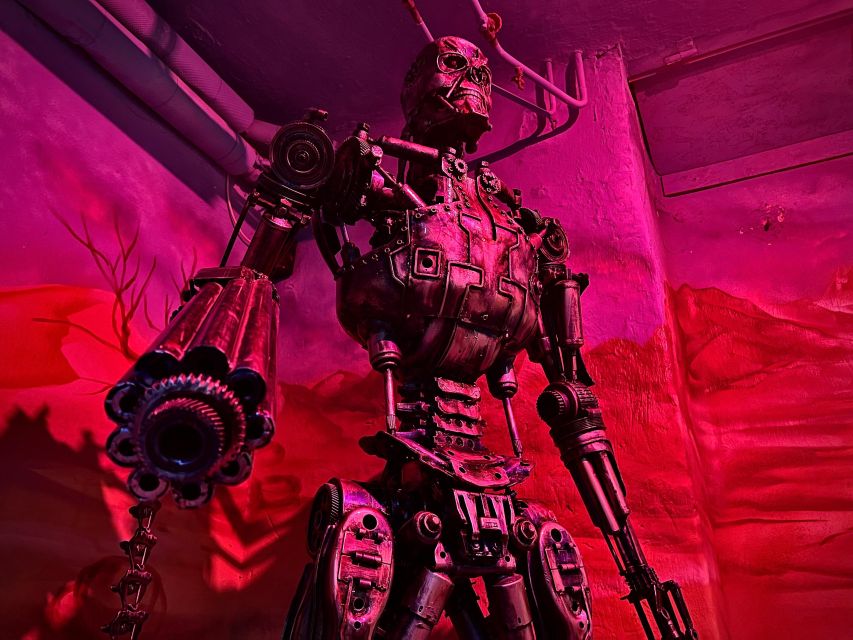
The headline here is the sculptures. They’re made entirely from recycled used car parts and scrap metal, and the makers clearly went for scale. The names you’ll hear on site include Megatron and Alien, plus other figures in the same spirit.
What makes this more interesting than a simple “junk art” idea is the transformation. You’re not just looking at a metal version of something—you’re seeing how car parts can become shapes, faces, bodies, and recognizable silhouettes. That’s why the figures feel so photo-ready. Many sculptures are positioned so you can frame them quickly, from angles that read well on a phone camera.
Also, because this is scrap metal art, you’re likely to notice the “made from parts” look up close: seams, curves, and the honest texture of the metal. That’s the kind of detail you can’t get from far away. So if you care about photos, plan to slow down in front of the big pieces and do a few angles instead of just one quick snap.
The space: 300+ sqm of art and trash, and why size matters
The museum is described as 300+ sqm of art and trash. On paper, that sounds like plenty. In practice, what matters is how that square footage is laid out.
Based on the way the exhibits are arranged, it’s more like a couple main rooms plus an extra smaller section. That’s good if you like to move fast and see everything without committing to a half-day. It’s not great if you were picturing a sprawling multi-hour “walk until your feet complain” attraction.
Here’s the honest way to plan it: think of it as a short, focused stop. You’ll likely be done sooner than you expect if you’re mainly there for photos. If you love metalwork details, you’ll naturally spend more time. But it’s still the kind of place where you can see the core exhibits without getting lost for hours.
Touch, selfies, and getting good photos without the museum police

If you’re coming with family or friends, this museum is built for group photos. The sculptures feel designed for it: you’ll see big forms that work for “stand next to it” shots, and the characters make instant visual impact even if you don’t know the backstory.
One reason people enjoy it is that you can get up close. There’s even a note from a visitor that you can touch the sculptures. That’s a big deal for two reasons:
- You can adjust your framing and distance in real time, instead of guessing from far away.
- The photos don’t feel sterile. They feel like you’re interacting with something physical.
If you want the best shot, don’t just do one pose. Do this instead:
1) Start with a full-body shot showing the whole sculpture.
2) Move to a face or feature close-up (even if it’s just the metal texture).
3) Finish with a “together” shot: you and whoever you came with, so the scale looks right.
And bring your patience for a practical reality: since it’s selfie-friendly, there may be moments where you’re waiting for someone to finish their pose. It’s still worth it, just don’t schedule this as the one thing you can’t be late for.
Price and value: $12 is fair if you match the vibe
The ticket price is $12 per person. That sounds simple, but value depends on what you want out of it.
If you’re expecting a museum experience with long explanations, this might feel pricey. There’s a strong “self-guided sculpture viewing” energy here, and at least one visitor noted there isn’t a guide in the usual sense. So you’re paying mainly for the entry and the time among the sculptures.
If, however, you want:
- close-up scrap-metal art,
- a fun place to take photos, and
- a quick, quirky cultural stop in central Hungary,
then $12 is easier to justify. It’s exactly the type of attraction that makes sense when you’re already doing a day of sightseeing and want something different from churches and courtyards.
A key consideration: some visitors felt the number of figures and total viewing time didn’t justify the cost. That tells me the museum’s “payoff” is front-loaded—meaning you should expect your best moments early as you work your way through the main rooms.
So my rule of thumb: if you’re the kind of person who spends 30 minutes on a “cool photos” stop, budget less time here but go in with clear expectations. If you’re the kind of person who loves details, plan to linger longer and you’ll likely feel the ticket was better value.






How long to plan: 1 day on the ticket, shorter in real life
The duration is listed as 1 day, and you’ll check availability for starting times. That doesn’t necessarily mean you’ll be there for hours. In fact, based on how the museum is described, it’s realistic to finish quickly—especially if your priority is photos.
Think in terms of a “short museum session.” You can do it as a calm activity between bigger sightseeing plans. It also works well with family because you don’t have to drag kids through a long, slow exhibition.
If you want a smoother experience, arrive when you’re fresh—because there’s no guarantee someone will slow things down for you with an organized tour. You’re going to be moving through on your own, so you’ll enjoy it more if you’re not rushing or hungry or tired.
Guides, hosts, and what the ticket does (and doesn’t) include
What’s included is straightforward: entry ticket for the museum.
As for people on site, there’s an English and Hungarian host/greeter. That suggests you’ll be welcomed, but it doesn’t guarantee a full guided tour with narration and long explanations.
One visitor specifically noted there wasn’t a guide in the way they expected. So if you’re the type of traveler who needs someone to tell you what each piece means, you might feel a bit on your own.
That said, you don’t really need a guide to enjoy scrap-metal sculptures. The experience is visual and physical. You’ll understand the “what” instantly and you can enjoy the “how it’s built” by simply looking closely.
Location tips: finding it fast and not losing time

The meeting point instruction is your best friend here: go through the bar and look for the stairs below. That’s the kind of detail that saves your whole trip. Places with a bar entrance can feel like you’re in the wrong building at first.
Once you’re inside, the museum layout seems to keep things simple: it’s made up of large areas plus a smaller section. So you likely won’t need a map to get oriented.
If you’re coming with a group, decide early who’s in charge of phones and who’s in charge of the group photo timing. The museum is built for selfies, so coordination helps you spend more time enjoying it and less time waiting.
Who should book: the best match for scrap-metal art lovers

This is a good fit if you:
- love unusual art made from recycled materials,
- want fast visual impact with giant figures,
- enjoy taking photos with family and friends, and
- prefer self-directed exploring over lectures.
It’s also a solid choice if you’re visiting around the Budapest area and want a stop that’s different from the usual classics. One visitor even called it out as not to skip when you’re in the Budapest area—so clearly it plays well as a day trip-style detour.
If you’re shopping for a long museum outing with lots of signage, guided storytelling, and deep interpretation, you may want to set your expectations lower. The scale is real, but the experience is still quick.
Don’t miss the fun: how the sculptures change your photo results
This museum is one of those places where the photos can be better than you expect. Why? Because scrap metal shapes can create strong shadows and dramatic angles. If you treat it like a “just snap it” stop, you’ll get fine results. If you treat it like a mini photo session, you’ll come away with the shots that look like you visited a themed character set.
Try this:
- Stand back for one full-figure shot, so the sculpture reads as giant.
- Move in for one close-up where you capture the metal-part texture.
- Use a friend for scale—your camera will do the rest.
And if the sculptures really are touchable in parts, you’ll get even better framing by testing distance rather than guessing. That makes the experience more playful and less museum-y.
Can you combine it with the rest of your day? Axe throwing option
The experience provider is listed as Axe Throwing and Trash Art Museum. That means the venue or company pairing includes axe throwing as another activity. The data you gave is focused on the museum ticket, so I can’t promise how they schedule both in the same slot.
But if your group includes people who want two different styles of fun—one visual and one active—this pairing is a hint. It could be a convenient way to keep everyone happy in the same stop instead of driving across town for a second activity.
Should you book the Trash Art Museum?
Book it if you want a quirky, photo-friendly scrap-metal art stop in central Hungary and you’re happy with a short, self-guided visit. At $12, it’s usually a fair price when your goal is giant characters like Megatron and Alien, made from recycled car parts, plus a good time with family and friends.
Skip it—or at least adjust expectations—if you’re hoping for a long museum experience with lots of figures, or a traditional guide explaining every piece. Some visitors felt the attraction is smaller than expected, and that’s the main reason you might feel underwhelmed if you’re expecting something big and time-consuming.
If you’re the kind of traveler who likes grabbing a fresh, unusual stop and moving on, this one fits nicely.
FAQ
How much does the Trash Art Museum cost?
The price is $12 per person.
How long is the experience?
It’s listed as a 1-day experience. You’ll check availability for starting times.
What’s included with the ticket?
Your entry ticket for the Museum is included.
Where do I meet for the visit?
Go through the bar and look for the stairs below.
What materials are the sculptures made from?
They’re made from recycled used car parts and scrap metal.
Are there specific sculptures I should look for?
Yes. The experience includes figures such as Megatron and Alien.
Is the museum guided?
Based on visitor feedback, there may not be a traditional guided tour. A host or greeter is listed, but it doesn’t read like a full docent-style experience.
What languages are offered?
Hungarian and English.
Is free cancellation available?
Yes. You can cancel up to 24 hours in advance for a full refund.
Do you offer reserve now and pay later?
Yes. Reserve now & pay later is available, so you can book your spot and pay nothing today.