REVIEW · BUDA CASTLE & FISHERMAN'S BASTION
Gems of the Budapest Castle District Walking Tour
Book on Viator →Bookable on Viator
Budapest’s statues talk when you walk. This Castle District tour links Holy Trinity, Matthias Church, and Fisherman’s Bastion into one 2-hour story, and I especially like the symbol-to-scene explanations and the photo-friendly views over Pest.
It’s guided with live commentary in English, and the pacing works because it’s not just staring at buildings. I also like that the group stays small (up to 45), and guides like Antel bring jokes and clarity to places that usually feel like random postcard stops.
The main thing to consider is effort: you’re on your feet for a solid stretch on hills and steps, so plan on comfortable shoes and bring patience for short stop times. And since the tour requires good weather, it’s smart to go when the sky is on your side.
In This Review
- Key things that make this walk worth it
- Why this Budapest Castle District tour feels practical
- Start at Holy Trinity Statue: symbols first, questions second
- Matthias Church: architecture notes you can actually spot
- Fisherman’s Bastion: legends, double crosses, and that Pest view
- Statue moments at the Pope and King Matthias crossroads
- National Archives of Hungary: Vienna Gate and Golden signatures
- Church of Saint Mary Magdalene: coronation mantle and WWII ruins
- Arpad Toth Promenade (Setany): flags, cannons, and siege history
- Mounted Andras Hadik: the knight you’ll remember
- The Labyrinth: a dungeon tale tied to Dracula/Vlad the Impaler
- Independence War Statue: revolution symbols, and a House of Houdini moment
- Szent György Street: power buildings and medieval castle ruins
- Buda Hill Funicular: a historic ride, a zero-kilometer stone, and a bridge claim
- Turul Bird and the Matthias Fountain: national myths to romantic tragedy
- Buda Castle courtyards: Lions Court and the Royal Riding Hall
- Prince Eugene of Savoy: a big statue with big meaning
- S. Maria Mater Dei and bridges: religion, monarchy, and visual connections
- Castle Garden and the Varkert Bazaar finish: spiral staircase and Triton fountain
- Pacing, group size, and value at $3.61
- Who should book this walking tour
- Should you book Gems of the Budapest Castle District Walking Tour?
- FAQ
- What is the duration of the tour?
- How much does the tour cost?
- What language is the tour offered in?
- Where do I meet the guide, and where does the tour end?
- Is a guide included?
- What happens if the weather is bad?
Key things that make this walk worth it
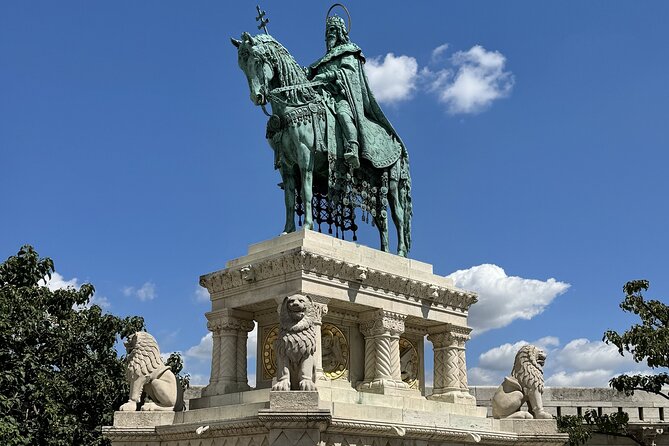
- Statues with meaning, not just selfies: each stop connects symbols to Hungarian stories and power.
- A viewpoint break at Fisherman’s Bastion: you get time for photos and legends, not only quick peeks.
- WWII history folded into the route: you pass memorials and viewpoints tied to the siege and aftermath.
- A Dracula-flavored stop underground: the Labyrinth cave adds a spooky thread to the day.
- Castle District highlights in tight time: Matthias Church, Buda Castle courtyards, and the Riding Hall show up without dragging.
- Guides in clear, fluent English: Antel’s style is repeatedly praised for being sharp and easy to follow.
Why this Budapest Castle District tour feels practical
This tour works because it doesn’t treat the Castle District like a museum maze. Instead, it reads like a guided walk through how Budapest tells its national story—religion, monarchy, revolution, war, and myths—shot through with viewpoints and landmark architecture.
The price is unusually low for a live guide walking you across so many famous sites. At $3.61 per person, you’re mainly paying for interpretation and timing, which is where this kind of walk can either be great or kind of flat. Here, the stops are set up so the guide can explain what you’re seeing in plain language while you’re still standing there.
You can also read our reviews of more walking tours in Budapest



Start at Holy Trinity Statue: symbols first, questions second
You begin at the Holy Trinity Statue by the castle hill area, and the first five minutes set the tone: the guide gives the background for the Holy Trinity column and explains what the figures represent. This matters because later stops reuse the same skill—connecting art to identity—so you’ll feel less like you’re just sprinting between famous names.
If you like tours where you understand the why behind the what, this start helps you keep score through the day. The only drawback is that the first stop is brief, so if you prefer a slower beginning, you’ll want to arrive a minute or two early and be ready to listen.
Matthias Church: architecture notes you can actually spot
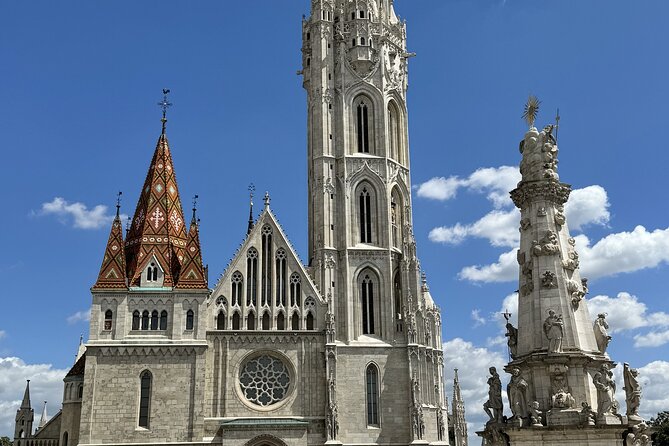
Next up is Matthias Church, where the guide focuses on the foundation story and specific architectural details. Even if you’re not an architecture nerd, you’ll usually notice what someone points out—materials, shapes, and the look of key elements—because you’re hearing the interpretation while your eyes are still fresh.
Matthias Church is also a good example of why this tour is worth more than a quick self-guided route. A phone audio guide can tell you facts. A live guide helps you connect those facts to the building’s visual language.
Fisherman’s Bastion: legends, double crosses, and that Pest view
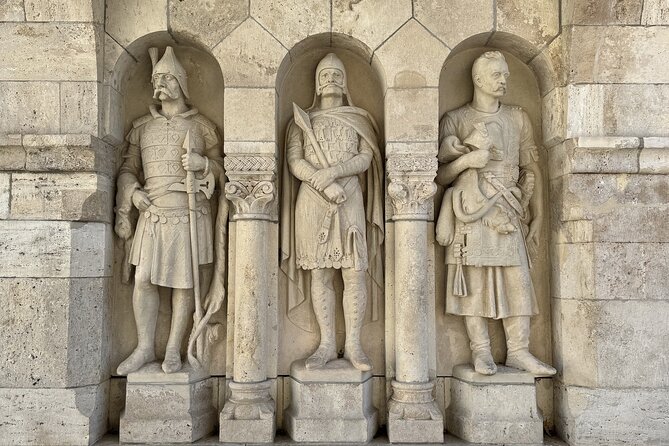
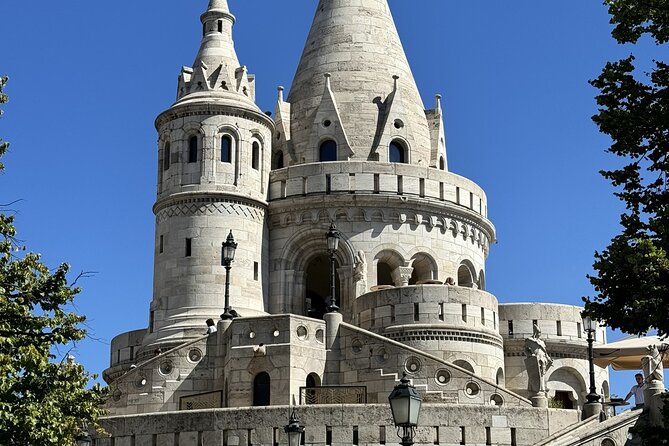
Fisherman’s Bastion is where the walk starts to feel like a show. You get time with statues, a discussion of the double cross and its relationship to the Hungarians, and a set of intriguing legends that make the stone feel less dead.
Then there’s the practical side: panoramic views toward Pest, plus a short break for photos. This is one of the best uses of your time because you’re getting a skyline moment and not just moving between stops.
One small consideration: the photos take longer than you think when you’re balancing other people’s angles. Give yourself breathing room and plan on staying flexible if there’s a crowd at the viewpoints.
Statue moments at the Pope and King Matthias crossroads
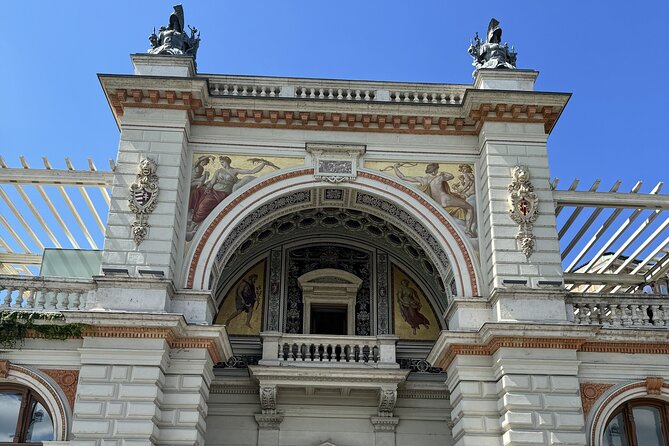
After the bastion comes a statue segment tied to Pope Innocent XI, with references to Pope Sylvester II and a coronation statue of king Matthias. You also hear about an oldest building of Hungary reference connected to this area. Even without deep prior knowledge, this stop helps you understand how the Castle District mixes religious authority and royal legitimacy in the same visual language.
These stops are short, but that’s part of the tour style. You’re not meant to park here for an hour—you’re meant to catch the thread and move forward with it.






National Archives of Hungary: Vienna Gate and Golden signatures
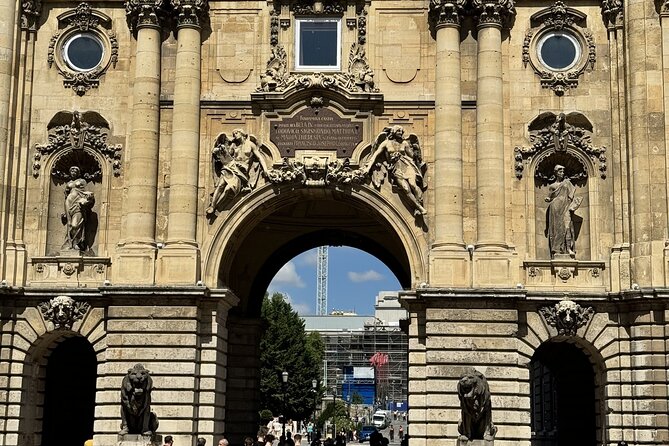
At the National Archives of Hungary, the focus shifts to architectural wonders and specific features you can look for: the Vienna Gate and Golden signatures on Uri street. The guide also points out statues nearby and explains the tales connected to the area.
This is a great stop if you like detail without homework. Instead of asking you to read plaques, the guide guides your eyes so you catch the elements that a quick walk-through would miss.
Church of Saint Mary Magdalene: coronation mantle and WWII ruins
The Church of Saint Mary Magdalene stop is built around symbolism and scars. You’ll hear about the coronation mantle of the Hungarian kings and see ruins tied to World War II.
That combination—ceremony on one side, destruction on the other—gives the tour extra emotional weight. It’s not just royal cosplay. You’re seeing how the same historic ground held both the pageantry and the damage.
Arpad Toth Promenade (Setany): flags, cannons, and siege history
Then you hit Arpad Toth Promenade, also called Setany, where the guide covers the first flag after WWII and a row of cannons. You also get a view of the Buda hills and a reference to the Statue of Szekely Knight.
The guide gives a brief history of WWII and the siege of Budapest, which is exactly what makes this area more than a pretty overlook. It’s also one of the places where you can feel time layering on itself—war, aftermath, and then the way the city rebuilt its story around these points.
Mounted Andras Hadik: the knight you’ll remember
Mounted Andras Hadik is next, and the guide frames him as the most famous Hungarian knight. This stop also connects to local trends, including the mention of the oldest Hungarian Confectionery.
If you like tours that end a story with something human—food, local pride, named personalities—this one helps. It gives you something to carry into your own wandering later, like, I want to try what locals still claim as theirs.
The Labyrinth: a dungeon tale tied to Dracula/Vlad the Impaler
The Labyrinth stop is a natural cave that was used as a dungeon, and the guide brings in the Dracula / Vlad the Impaler storyline. For many people, this is the most fun tonal shift on the whole route—after serious symbols and wartime references, you get a spooky narrative that’s easy to visualize.
You’ll likely spend about ten minutes here. That’s enough time to hear the story and walk the space without turning it into a full attraction visit.
Independence War Statue: revolution symbols, and a House of Houdini moment
Next is the Statue of Independence, with background tied to the Hungarian revolution of 1848. The guide connects the statue’s symbolism back to the war, so it doesn’t feel like a random monument stop.
There’s also a House of Houdini mention in this area, which adds a playful contrast. That kind of tonal balance keeps the tour moving and helps you avoid the monotony that can hit long walks.
Szent György Street: power buildings and medieval castle ruins
On Szent György Street, you pass offices of the president and prime ministers and also spot ruins of medieval castles. This is where politics meets history in a very literal way: the government shows up on land shaped by older power.
The guide also adds secret stories, which is exactly the right kind of hook for this section. Not every stop needs a major “wow.” Some just need context that makes the street feel alive.
Buda Hill Funicular: a historic ride, a zero-kilometer stone, and a bridge claim
Then you reach the Buda Hill Funicular stop, described as the second oldest funicular. The guide highlights a zero kilometer stone and the oldest bridge of Hungary reference.
This stop is useful even if you’re not riding anything. It helps you understand how the Castle District connects to the city through old infrastructure, not only through views and royal buildings.
It’s also a good place to take a breath. After lots of quick statue-and-legend moments, you get a small “slow down” step before the next cluster of landmarks.
Turul Bird and the Matthias Fountain: national myths to romantic tragedy
The Turul Bird Statue comes next, built around the national bird of Hungary and the background of the naming of the Hungarians. This is the kind of story that’s hard to find just by reading a sign. With the guide’s narration, the statue becomes a clue, not just a shape in metal or stone.
Soon after, you reach the Fountain of King Matthias, described as the prettiest fountain of Budapest and tied to a romantic-tragedy. If you enjoy how folklore and public art overlap, this section is a strong emotional beat in the middle of the route.
Buda Castle courtyards: Lions Court and the Royal Riding Hall
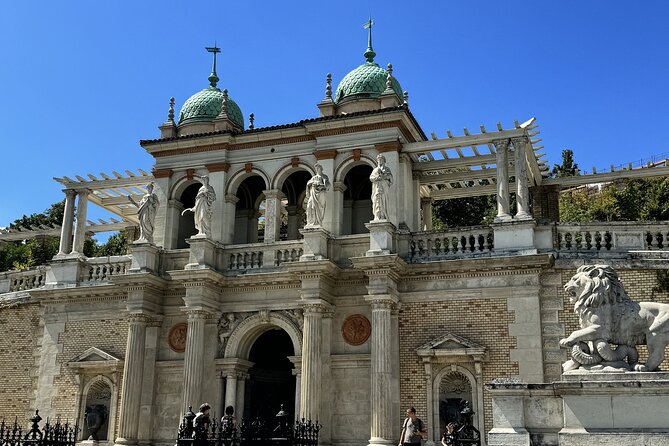
Inside the Castle District, you enter Lions Court (Buda Castle), where the guide explains mythical statues on the facade. This is a strong “look closer” moment—because the facade details are easy to miss unless someone directs your attention.
Next is the Royal Riding Hall, the royal Hungarian stable. Even though the stop is short (about two minutes), it works because it connects the building to the people and purpose behind it, not only the exterior look.
Prince Eugene of Savoy: a big statue with big meaning
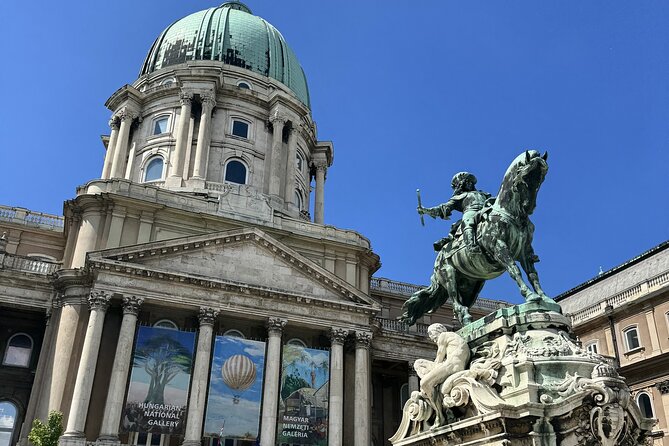
The Prince Eugene of Savoy equestrian statue is one of the biggest stops in scale on the route. The guide frames him as the liberator of the Hungarians from the Ottomans and shares fun facts, which helps you read the statue’s size as more than spectacle.
When a tour moves through so many points quickly, scale changes are important. This one gives your eyes a reset and your brain a “major chapter” feeling.
S. Maria Mater Dei and bridges: religion, monarchy, and visual connections
At S. Maria Mater Dei, the guide points out the Virgin Mother Mary with baby Jesus statue and connects it to bridges of Budapest in relation to Hungarian monarchs. This is one of those stops that might sound abstract—until you realize the guide is linking a faith symbol to the broader way the city credits its rulers and stories in public spaces.
These short bridges-between-themes moments are what keep the walk from feeling like a checklist.
Castle Garden and the Varkert Bazaar finish: spiral staircase and Triton fountain
The tour ends by moving into Castle Garden, where you’ll hear about the spiral staircase tower and the Triton fountain. Then you finish at Castle Garden Bazaar at the foot of the castle hill by the Varkert Bazar, with a focus on the bazaar architecture and statues on the facade.
This ending is nice because it’s less “hard stop.” Gardens and facades are easy to wander after the tour, and you can keep your momentum without needing to instantly plan your next move.
Pacing, group size, and value at $3.61
The tour runs about 2 hours 10 minutes, starting at 3:00 pm. That timing is convenient if you’re already in the area later in the afternoon, and it also pairs well with views—Fisherman’s Bastion is a prime spot when the sky is cooperating.
Group size maxes at 45, which helps keep the guide’s voice clear and the walk from turning into a stampede. One of the standout things in the guide feedback is that English stays very clear—Antel is specifically praised for articulate explanations and a good sense of humor, especially at Fisherman’s Bastion’s tight corners and statue clusters.
The big value point here is that the listed stops are admission ticket free in the tour flow. So you’re not paying extra again and again for entrance fees. Instead, you’re paying for the guided context that makes the free stops feel worth your attention.
If you don’t mind a brisk pace with short explanation bursts, this tour is a smart way to compress a lot of Budapest Castle District highlights into one well-told walk.
Who should book this walking tour
This one fits you best if you want:
- a guided intro to Budapest Castle District without spending half a day on logistics
- lots of photo opportunities, especially at Fisherman’s Bastion
- stories tied to statues, wartime history, and national symbols rather than only dates and names
- clear English narration from a guide like Antel who makes details easy to follow
If you hate walking, need long sit-down museum time, or prefer deep, slow reading at every stop, you may feel rushed. But for a two-hour window, it hits a sweet spot.
Should you book Gems of the Budapest Castle District Walking Tour?
Yes, if you want the Castle District with meaning, not just views. The mix is well balanced: early symbol explanations, a major viewpoint moment with photos, WWII references, a spooky cave story, and then the royal-courtyard finish.
I’d especially book it if you value great English guidance and you like to understand what you’re looking at before you leave. It’s also a good choice when you’re trying to see a lot without paying entrance fees, since the stops are described as free in the tour flow.
FAQ
What is the duration of the tour?
The tour lasts about 2 hours 10 minutes.
How much does the tour cost?
The price is $3.61 per person.
What language is the tour offered in?
The tour is offered in English.
Where do I meet the guide, and where does the tour end?
You start at Holy Trinity Statue on Szentháromság u., 1014 Hungary, and end at Castle Garden Bazaar at the foot of the castle hill by the Varkert Bazar, Ybl Miklós tér 2-6, 1013 Hungary.
Is a guide included?
Yes. The tour includes a live guide.
What happens if the weather is bad?
The tour requires good weather. If it’s canceled due to poor weather, you’ll be offered a different date or a full refund.