REVIEW · JEWISH QUARTER & SYNAGOGUE TOURS
A Journey through Jewish Budapest – Walking Tour
Book on Viator →Operated by Insight Cities · Bookable on Viator
Jewish Budapest hits you in the heart. This 3-hour walk links major sights in the Jewish quarter with WWII memory along the Danube, so you see how Budapest’s Jewish life and tragic history shaped real neighborhoods. I especially like the small-group feel and the focus on three synagogues instead of quick photo stops.
What makes it work is the guide. You’re traveling with a historian guide, and the tour is led by people like Orsolya, Agi, Endre, and Veronika—each one brings strong context that connects Hungarian history to the Jewish community’s day-to-day life, not just dates on a wall. That combination—story + place—makes the whole route feel organized, not overwhelming.
One thing to plan for: several key sites require separate admission tickets, and you’ll want to dress for synagogue entry. Shoulders and knees need to be covered for the Dohány and Kazinczy synagogues, and if you show up in shorts and tank tops, you’ll feel it fast.
In This Review
- Key things you’ll notice on this walk
- Meeting at Kamara Café and getting oriented fast
- Dohány Street Synagogue: Europe’s largest temple complex
- The part people remember: courtyard details and the Tree of Life
- Kazinczy Street and the Ghetto Wall Memorial (2014)
- Rumbach Street Synagogue and the Status Quo Ante tradition
- Shoes on the Danube Bank: where the route lands emotionally
- Why this route makes sense: Buda Castle, Pest, and real neighborhoods
- Price and value: what $126.16 really buys
- What to wear, bring, and expect during the stops
- Who this tour fits best (and who might skip it)
- Should you book this Jewish Budapest walking tour?
- FAQ
- How long is the walking tour?
- Where does the tour start and end?
- What time does the tour start?
- Is the tour offered in English?
- Is pickup available?
- How big is the group?
- Are food and drinks included?
- Do I need to buy tickets for the sights?
- Is there a dress code?
- What’s the cancellation policy?
Key things you’ll notice on this walk
- Three synagogue interiors (when open), not just exteriors across different traditions and eras
- Dohány Street complex with the Temple of Heroes, Jewish Museum, and a Memorial Park inside the site
- Ghetto Wall Memorial (2014) near Kazinczy Street, tying the route to modern remembrance
- Mikve and Art Nouveau orthodox synagogue details that explain how ritual life shaped the area
- Shoes on the Danube Bank (free), a WWII memorial you don’t rush through
Meeting at Kamara Café and getting oriented fast
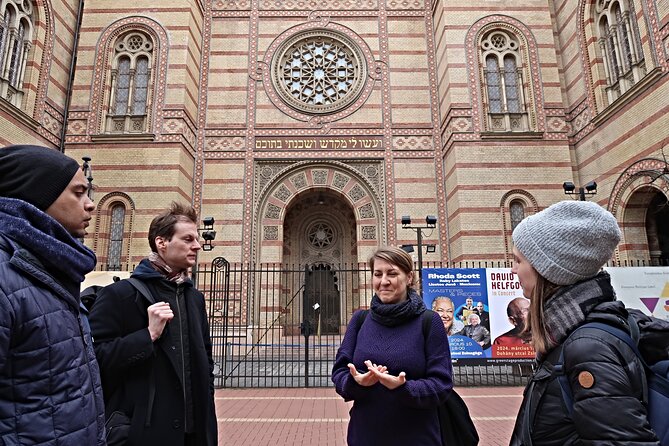
You start at Kamara Café on Dohány Street, right by the Great Synagogue. It’s an easy launch point because you’re already in the right neighborhood from step one, and the tour notes that it’s near public transportation.
From there, the pace stays walkable. You’re on a classic city route through the Jewish quarter and beyond, and you’re moving between landmarks that are close enough to feel connected, but different enough to show how Budapest changed over time. With a group capped at six (and an overall maximum of eight), you’re not squeezed into a giant crowd.
This is the kind of tour where the guide helps you read the streets. You’ll be looking at facades and courtyards, but also learning why the buildings are where they are and how power, community, and tragedy changed the area.
You can also read our reviews of more walking tours in Budapest



Dohány Street Synagogue: Europe’s largest temple complex
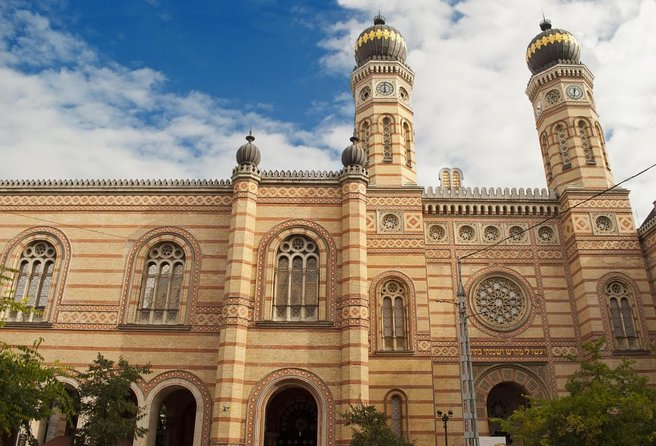
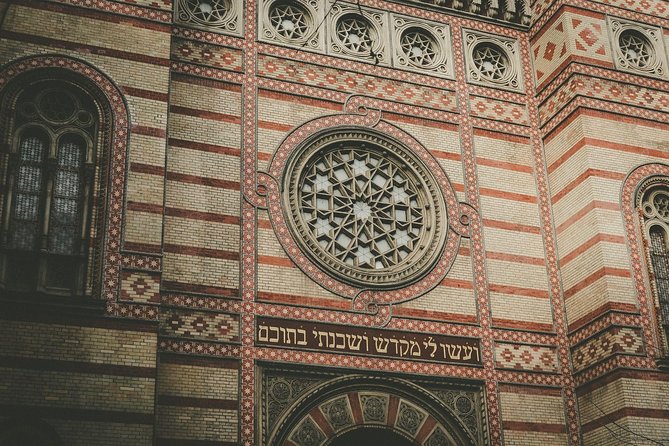
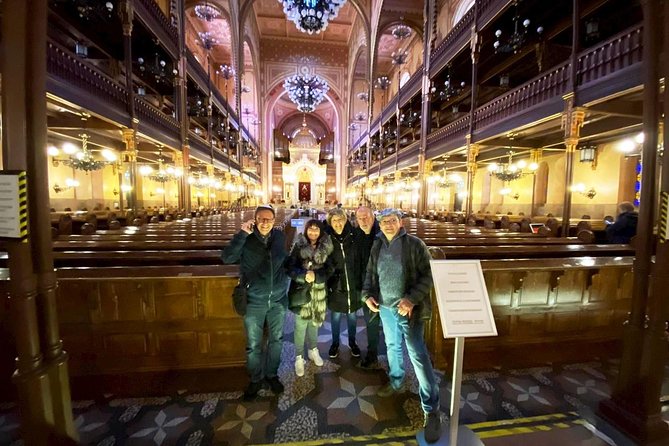
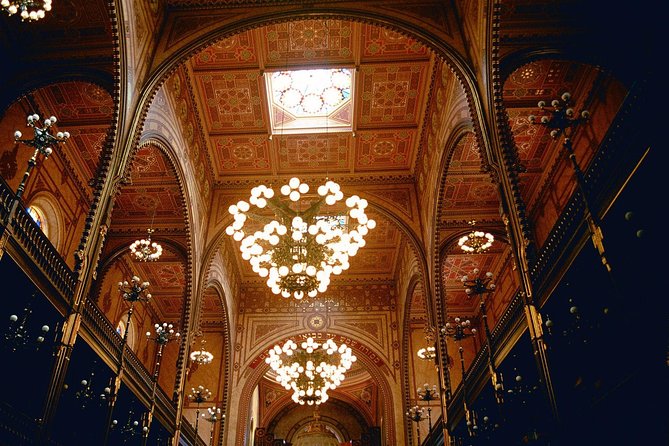
Stop one is the Great / Central Synagogue (Nagy Zsinagóga), the Dohány Street Synagogue complex. This is the big visual anchor of the tour: Moorish Revival styling with lavish detail that can look almost unbelievable against a real city street.
The tour also emphasizes that you’re not just admiring architecture. You’re guided through the complex with a Jewish studies scholar and/or historian-style interpretation, then you see key parts inside, including:
- the Temple of Heroes
- the Jewish Museum
- the Memorial Park within the grounds
A practical note: the tour includes guided time at this stop, but admission tickets aren’t included. So you’ll want to plan for extra entry cost before you arrive. Also, the synagogue requires shoulders and knees covered. Bring light layers if you’re traveling in warmer months.
What I like about this stop is that it sets context before the walk turns darker. You start with scale and beauty, then you’re prepared to understand why memory sites matter so much here.
The part people remember: courtyard details and the Tree of Life
One of the most memorable aspects people point out at the Dohány complex is the courtyard and the Tree of Life. That kind of detail is exactly why a guided route beats trying to do everything alone.
When you’re on your own, you might spot the main building, take the picture, and miss the symbolism that’s sitting a few steps away. On this tour, the guide helps you connect those details to Jewish artistic tradition and community identity.
The trade-off is time. Since the complex contains multiple areas (synagogue, museum, memorial sections), you may want to mentally prepare for a “there’s a lot here” feeling—good for visitors who love structure, not ideal if you prefer totally free wandering.
Kazinczy Street and the Ghetto Wall Memorial (2014)
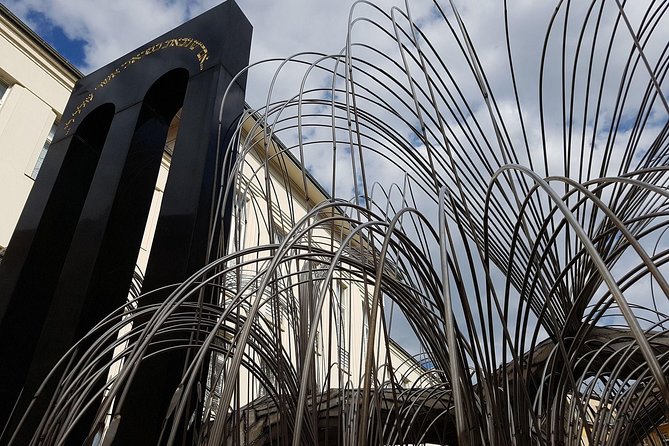
Next you walk to Kazinczy Street Synagogue. Before you reach the synagogue, you pass the Ghetto Wall Memorial, erected in 2014. That’s an important modern layer in the story: it shows Budapest is still actively marking this history, not treating it as something sealed in the past.
Then comes a set of details that turns the area into something more than a label on a map:
- a luxurious mikve (Jewish ritual bath)
- the Art Nouveau orthodox synagogue on Kazinczy Street
- a chance to visit the interior when it’s open to the public
Like the first synagogue stop, admission tickets aren’t included, and the guide’s job here is to explain how different Jewish practices lived side by side in the same city block life—religion wasn’t abstract. It was rooms, routines, and community buildings.
The same dress rule applies: shoulders and knees covered are requested for both the Dohány and Kazinczy synagogues. If you’re traveling with a light scarf or a thin cardigan, you’ll be glad you packed it.
Rumbach Street Synagogue and the Status Quo Ante tradition
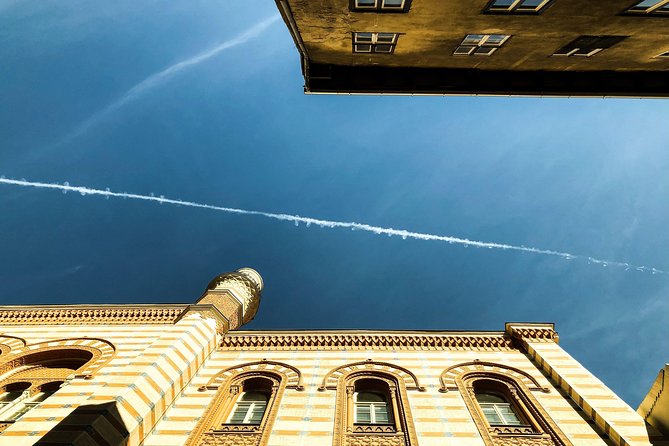
Stop three is the Rumbach Street Synagogue. What makes it distinct is the focus on the Status Quo Ante stream of Judaism—basically, an interpretation tied to how Jewish communities managed differences and decisions about practice.
You’ll observe the synagogue while learning what that means historically, and you may visit the interior when it’s open to the public. Like the other synagogue stops, admission tickets aren’t included.
This part of the walk works well if you like contrasts. By now you’ve seen the scale of Dohány, the neighborhood memory near the ghetto wall, and ritual space at the mikve. Rumbach Street adds a more specific lens on how internal community life and religious decision-making shaped the buildings people worshipped in.






Shoes on the Danube Bank: where the route lands emotionally
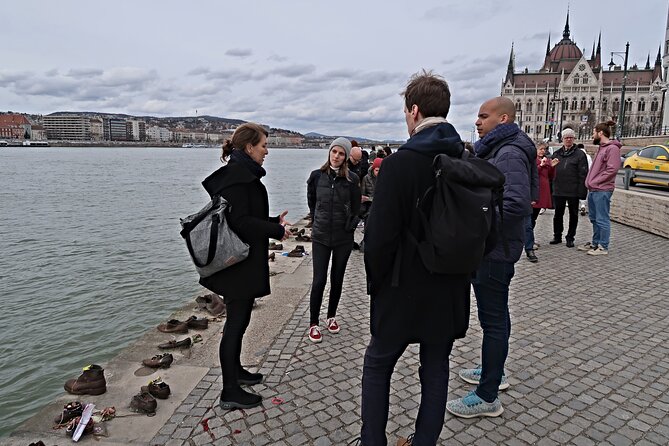
The tour ends at Shoes on the Danube Bank, a WWII memorial created on April 16, 2005. This one is free, and it’s also where the story becomes painfully direct.
The memorial’s message is simple and crushing: Jews were ordered to take off their shoes, were shot at the water’s edge, and their bodies were carried away by the river. The sculpture represents those shoes left behind on the bank.
You’ll want to pause here, not just snap a photo and move on. This is not a “check it off” stop. It’s a moment to slow down and let the meaning land.
The route finishes right here, so you can transition back into the city at your own pace after the tour. It’s a good ending because it connects Jewish Budapest’s history with what modern Budapest chooses to remember in the most public place possible.
Why this route makes sense: Buda Castle, Pest, and real neighborhoods
The tour’s selling point isn’t only the synagogues. It’s the way the route connects the Jewish quarter area (with references to the former Pest ghetto) to broader Budapest context, including the Buda Castle district.
That matters because Jewish history in Budapest isn’t one single story. It’s an evolving city story—migration, community growth, segregation, persecution, survival, and memory. When your guide links each stop to the neighborhood around it, you start seeing the city the way locals do.
You’ll also notice how the tour balances architecture and remembrance:
- Dohány Street gives you beauty and scale
- Kazinczy brings you into ghetto-era memory markers and ritual life
- Rumbach adds specific tradition and community structure
- the Danube memorial closes with WWII tragedy
If you’re the type who likes your sightseeing with context (and can handle serious topics), this is a strong fit.
Price and value: what $126.16 really buys
The tour costs $126.16 per person and runs about 3 hours. For that price, you’re getting a guided walking experience plus a historian guide.
What you’re not getting: admission tickets to the synagogues (Dohány, Kazinczy, Rumbach). The memorial by the Danube is free, but several major sights are ticketed.
So the real value question is this: are you paying for the guide’s ability to explain what you’re seeing, plus the convenience of a planned route through multiple sites? In my view, yes—especially because this tour isn’t about random stops. It’s built around major Jewish landmarks and the WWII memorial, with enough guidance that you won’t feel lost in the details.
Small-group size (max eight) also matters here. Religious buildings and memorial spaces can feel intense and physically tight. A smaller group helps you keep your bearings, ask questions, and not rush through places where the meaning should take a few minutes.
If you’re someone who hates paying separate site fees, you’ll want to account for those synagogue admissions upfront before you budget.
What to wear, bring, and expect during the stops
This tour has a few practical rules that are worth taking seriously:
- Synagogue entry requires shoulders and knees covered for the Dohány and Kazinczy synagogues.
- The route is a walking itinerary across central Budapest, so wear shoes that handle regular city walking.
- Interiors are visited when open to the public, so don’t expect every room to be accessible no matter what.
What else helps:
- Bring a light layer even in warm weather in case you need coverage.
- Have some water and a snack plan, because food and drinks aren’t included.
- Mentally prepare for a mix of architectural admiration and heavy WWII subject matter.
One extra bonus that shows up with some guides: food and local notes. I’ve seen this tour’s guides include Jewish culinary suggestions, including the flodni cake recommendation that people found delicious. Even if you don’t plan to buy anything during the walk, it’s a nice way to connect history to everyday culture.
Who this tour fits best (and who might skip it)
This is a smart choice if you:
- want Jewish history connected to specific buildings, not generic museum talk
- like small-group guiding with time to understand each stop
- can handle WWII memory sites with respect and seriousness
- appreciate that the guide work includes both community heritage and Hungary’s broader context
You might look at other options if you:
- only want quick exterior sightseeing and don’t want separate synagogue admissions
- prefer purely lighthearted sightseeing with no heavy memorial content
- dislike any dress constraints and don’t want to plan for covering shoulders and knees
Should you book this Jewish Budapest walking tour?
Yes—if you want a structured, thoughtful way to understand Budapest’s Jewish quarter without feeling like you’re guessing your way through it. The combination of three synagogue stops, a ghetto-era memory marker, and the Danube memorial gives you a full emotional and historical arc in a short time.
Also, the small-group size and the presence of a historian guide make a difference here. You’re not just walking past famous buildings; you’re learning what they mean and why they’re linked.
Book it now if you like guided clarity and you’re okay paying separate entry fees for the synagogue complex sites. If you’d rather avoid dress rules or ticket add-ons, then it may feel like too many “extras” for a 3-hour walk.
FAQ
How long is the walking tour?
It runs for approximately 3 hours.
Where does the tour start and end?
The tour starts at Kamara Café, Dohány u. 1b (also listed as Dohány u. 1a) in Budapest, and ends at Shoes on the Danube Bank in Budapest 1054.
What time does the tour start?
The provided start time is 10:00 am, and there is also a choice of morning or afternoon departure.
Is the tour offered in English?
Yes, it’s offered in English.
Is pickup available?
Pickup is offered, with the meeting point tied to Kamara Café. You receive your guide’s photo, phone, and bio after booking.
How big is the group?
The tour is limited to six people for a small-group feel, with a maximum of eight travelers.
Are food and drinks included?
No, food and drinks are not included.
Do I need to buy tickets for the sights?
Admission tickets are not included for the Dohány Synagogue, Kazinczy Street Synagogue, and Rumbach Street Synagogue. The Shoes on the Danube Bank memorial is free.
Is there a dress code?
Yes. Visitors to the Dohány and Kazinczy synagogues are requested to have shoulders and knees covered.
What’s the cancellation policy?
You can cancel for a full refund up to 24 hours in advance. Free cancellation is available, but cancellations within 24 hours of the start time are not refunded.